Real Stories, Real Outcomes: What Rent-to-Own Looks Like When It Works
- By now, you’ve seen the full framework of Rent-to-Own:
- Blog 28: The basics of RTO and why India needs flexible ownership options
- Blog 29: The legal and documentation principles that keep RTO safe and enforceable
But understanding the model is one thing. Seeing how it changes real lives is another
Rent-to-Own is still growing in India, but globally it has helped thousands bridge the gap between renting and owning.
This final blog brings together real-life stories, global trends, and practical lessons to help readers see themselves in the journey.
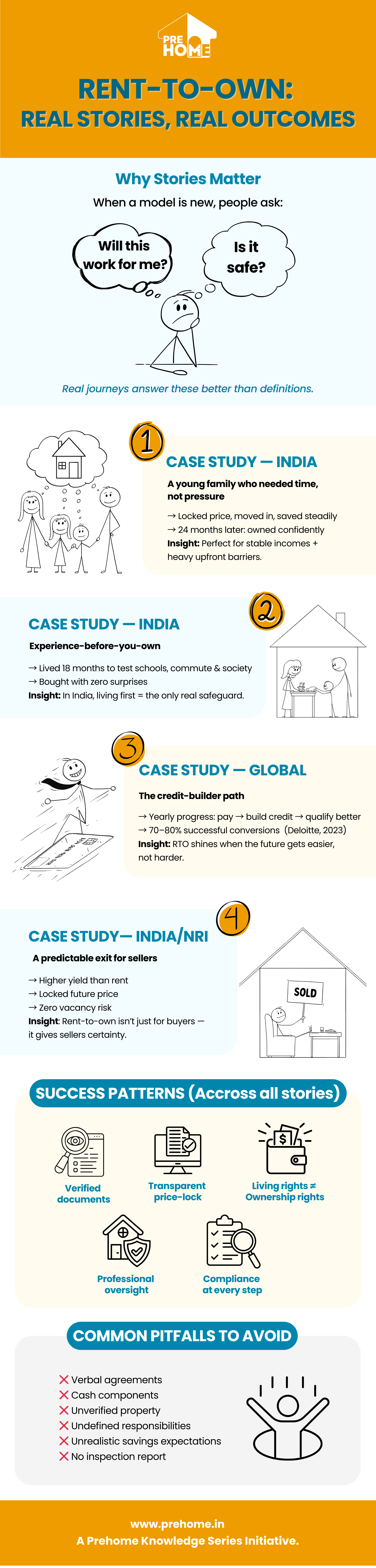
1. Why Stories Matter When The Model Is New
- When a concept is unfamiliar, people naturally ask:
- “Will this work for someone like me?”
- “Is it safe?”
- “What if something goes wrong?”
- “How do I know I’m not making the wrong decision?”
Stories answer these questions through lived experience — they show what data cannot.
2. Case Study 1 (India): The Young Family Who Needed Time, Not Pressure
- Profile:
- Couple working in Gurgaon
- Combined income: ₹22 lakh (but sporadic since they had started their own firm)
- Looking at a 1.2 crore home
- EMIs were manageable, but the ₹24 lakh down payment was not
- What they did:
- Chose a verified 3BHK through a structured Rent-to-Own model
- Locked a fair future price
- Moved in immediately
- Built savings over 24 months
- The outcome:
- Rental inflation no longer affected them
- Their savings stayed ahead of home price movement
- They transitioned into ownership smoothly
- No pressure, no buyer’s remorse, no frantic down payment scramble
- The insight:
- Rent-to-Own works exceptionally well for households with stable income but heavy upfront barriers.
3. Case Study 2 (India): The “Experience Before You Own” Journey
- Profile:
- Family relocating to Gurgaon from Delhi
- Unsure about:
- Schools
- Commute
- Society culture
- Locality safety
- Noise levels and natural light
- What they did:
- Used a structured RTO pathway to live in the home for 18 months
- Tested everything in real life
- Evaluated whether the home fit their future
- The outcome:
- Their eventual decision was based on real experience, not a sample flat
- 18 months later, they bought confidently
- Zero surprises and zero regret
- The insight:
- In India, where sample flats rarely reflect reality, “live before you buy” is not a luxury — it’s a safeguard.
4. Case Study 3 (Global): The Credit Builder Success
- In the US and Canada, Rent-to-Own is commonly used by families building creditworthiness. A Deloitte 2023 housing brief showed:
- Structured RTO programs have 70–80% successful conversions
- Most participants improve their credit score while renting
- Clear price locks reduce anxiety around rising markets
- A typical journey looks like this:
- Year 1: Build credit history through consistent payments
- Year 2: Improve financial documentation
- Year 3: Qualify for a mortgage at a better rate
- The insight:
- RTO works best when the future goal (a mortgage) becomes easier over time — not harder.
5. Case Study 4 (India/NRI): The Predictable Exit Strategy
- Profile:
- NRI homeowner in Dubai
- Owned a 2BHK in Pune
- Wanted to sell but didn’t want low-ball offers or market uncertainty
- What they did:
- Entered a structured RTO agreement with a 2-year window
- Received higher yield than traditional rent
- Locked a future exit price
- Avoided negotiation fatigue
- Eliminated the risk of unplanned vacancy
- The outcome:
- Predictable sale
- Predictable yield
- Zero micro-management
- No distress sale
The insight:
RTO is not only a buyer-friendly model. When done professionally, it is equally powerful for sellers who value predictability.
6. Patterns Across Successful Rent-to-Own Journeys
- Across India and global markets, the most successful RTO stories share five traits:
- Transparent pricing: No ambiguity, no verbal commitments, no surprises.
- Documentation clarity: A clear separation of today’s living rights and tomorrow’s purchase rights.
- Realistic savings and affordability planning: The model works best when buyers build savings steadily rather than hurriedly.
- Verified, curated properties: Unverified properties are the biggest source of disputes — which is why RTO must begin with vetted homes (Blog 28).
- Professional inspections: Globally, every structured RTO model uses pre-move-in condition reports to ensure fairness.
These patterns validate the strength of structured pathways versus informal arrangements.
7. Common Pitfalls and How to Avoid Them
- Even though structured RTO is robust, the informal versions can be risky. Here are the pitfalls seen across markets:
- Choosing the wrong home: Rushing into a home that doesn’t match long-term needs often derails the journey.
- Verbal agreements: India’s courts do not enforce verbal price locks.
- Lack of clarity on responsibilities: Repairs, maintenance, and society dues must be clearly allocated.
- Unrealistic savings expectations: RTO provides time, not a shortcut. Savings discipline still matters.
- Ignoring documentation quality: Unregistered agreements or unverified titles can lead to disputes.
- Engaging without structure: The model only works when implemented professionally.
8. A Simple Home Seeker Checklist for Anyone Considering Rent-to-Own
- Before entering an RTO arrangement, ensure:
- Property documents verified
- Future price clearly written and agreed
- Contribution structure understood
- Responsibilities clearly defined
- Payment trail digital and transparent
- No cash components
- Clear purchase window timeline
- Pre-move-in inspection completed
- Clear exit terms
This checklist alone eliminates 90% of the risks seen in informal arrangements.
The Final Word: The Future of Flexible Homeownership
Rent-to-Own is not about replacing renting or buying. It’s about recognising a simple truth:
Homeownership in India needs more flexible pathways — pathways aligned with today’s financial realities, mobility, and aspirations.
- Across the three blogs in this topic, we explored:
- Blog 28: How RTO works and why India needs it
- Blog 29: The legal framework that keeps it safe
- Blog 30: How real families and homeowners use it successfully
As India evolves, so will the ways we own homes. Rent-to-Own is not just a bridge — it is a plan for a new type of housing mobility and financial planning.