The Legal & Documentation Handbook — What Makes Rent-to-Own Safe in India?
Rent-to-Own can bring significant change, but only when the legal framework is strong. In India, where property laws differ by state and documentation can be inconsistent, informal agreements are common. Clarity is essential; it builds trust.
This blog looks at the principles that protect both buyers and sellers without disclosing proprietary contract details.
It's about what good Rent-to-Own should achieve, not the intricate clauses behind it.
In Blog 28, we covered the basics of Rent-to-Own and why it suits India's changing housing market.
Now, we address the next question: "How do you make a long-term, future-linked property arrangement safe, clear, and enforceable?"
1. Why Legal Structure Matters More in Rent-to-Own Than in Renting or Buying
A rent agreement usually lasts 11 months, while a home purchase is often a one-time deal. Rent-to-Own sits between these two options.
- It involves:
- Living in the home today
- Locking a price for the future
- Making structured payments
- Transitioning into ownership later
- This creates a relationship that lasts several years and involves multiple commitments. India’s real estate market has its unique challenges:
- Title clarity varies by region: Some states have digitized land records; others do not.
- Informal agreements are still common: Verbal promises, WhatsApp messages, and cash transactions are all unenforceable.
- Builder and society approvals can differ: Some buildings have restrictions on long-term leasing or partial occupancy.
- Ownership and possession rights must be clearly defined: to ensure fairness for both parties.
Due to these factors, Rent-to-Own in India cannot thrive through casual, DIY arrangements. It needs a solid structure.
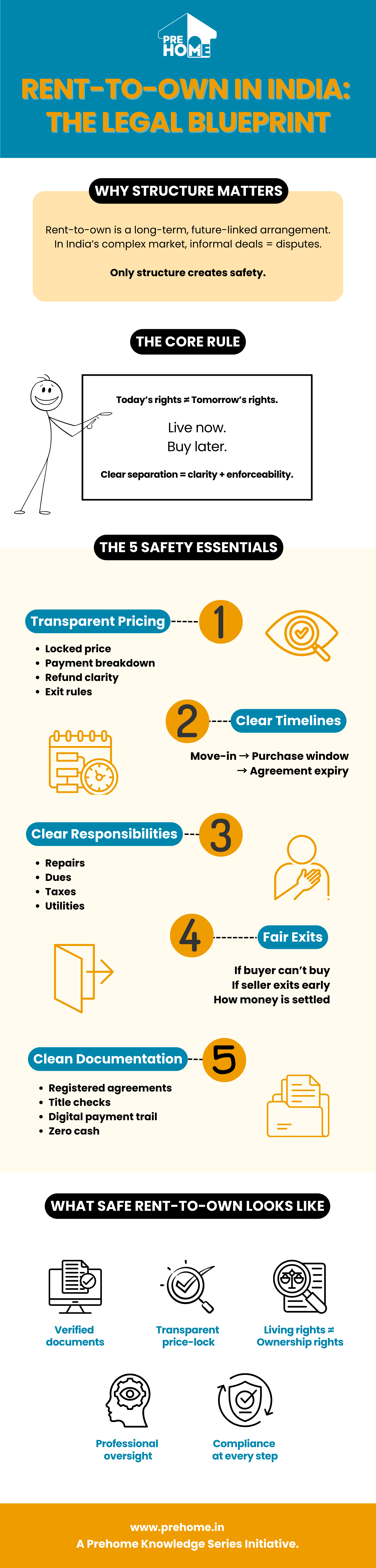
2. The High-Level Architecture of a Safe Rent-to-Own Pathway (Explained Simply)
Separate Every country that successfully uses Rent-to-Own—the US, Canada, the UK, and Australia—relies on one key principle: Separate today’s rights from tomorrow’s rights. In India, this principle must be applied with additional care
- This means:
- One layer governs the right to live in the home
- Another governs the right to buy the home in the future
Instead,We will not delve into clause-level details here. Instead, we will focus on the outcomes this structure must guarantee to protect both parties.
3. The 5 Outcomes Every Rent-to-Own Framework Must Guarantee
These outcomes reflect global best practices and considerations specific to India.
Outcome 1: Transparent Pricing and Zero Ambiguity
- A buyer should know:
- The locked future price
- Whether the price is fixed or indexed
- If/Any part of monthly payments count toward ownership
- What happens if they choose not to purchase
- A seller should know:
- Their future exit price
- What happens if the buyer exits early
- What obligations apply during the occupancy period
Lack of clarity is the leading cause of disputes in informal property deals across India.
Outcome 2: Clear Timelines
- Rent-to-Own works only when timelines are explicit:
- Move-in period
- Purchase window
- Milestones
- Agreement expiry
- Notice requirements
Timelines protect buyers from sudden changes and protect sellers from indefinite waiting.
Outcome 3: Clear Responsibility Allocation
- A structured RTO model clearly outlines who manages:
- Minor repairs
- Major structural repairs
- Society dues
- Utilities
- Insurance
- Property taxes
This ensures the home remains maintained, valuable, and free from disputes.
Outcome 4: Clear and Fair Exit Pathways
Life circumstances change.
- A safe Rent-To-Own framework must account for:
- What happens if the buyer cannot proceed
- What happens if the seller needs early settlement
- How payments settled so far are treated
- What counts as refundable or non-refundable
Fairness is essential to avoid long-term disputes.
Outcome 5: Clear Documentation and Compliance Trail
- This includes:
- Registered agreements
- KYC
- Verification of ownership
- Encumbrance checks
- Digital audit trail of payments
- Zero cash components
- Society approvals (where applicable)
This is the difference between risk and reliability.
4. The Mistakes That Derail Informal Rent-to-Own Deals in India
- Rent-to-Own is often attempted informally among friends or through brokers. Most fail due to these common pitfalls:
- Verbal commitments on future price: These are unenforceable and often lead to disputes when markets shift.
- Cash components: Create tax issues for sellers and zero protection for buyers.
- Unregistered agreements: Have no legal strength.
- Undefined maintenance rules: Often causes friction within months of occupancy.
- No documented inspection report: Leads to arguments over existing damage or quality issues.
- No clarity on refundability: Buyers assume refunds while sellers assume non-refundable contributions — creating conflict.
These pitfalls explain why global Rent-to-Own models moved to structured frameworks decades ago — and why India must too.
5. What We Can Learn from Global Rent-to-Own Models
- Countries where RTO is well-established (like Canada and Australia) have three common features:
- Verified documentation: Nothing moves without clear compliance.
- Third-party oversight: Ensures neither side misinterprets commitments.
- Clear separation of rights: Living rights ≠ Ownership rights.
- Transparent price-lock mechanisms: No ambiguity, no surprises in renegotiation.
- Professional inspections: Before move-in, and sometimes before purchase.
India is still at an early stage in adopting structured Rent-to-Own, but the underlying safety principles remain the same.
6. When to Seek Professional Support in a Rent-to-Own Journey
- Given the complexity of property transactions in India, getting professional guidance is essential when:
- You want transparent pricing
- You need clarity about future legal obligations
- You want compliance-proof documentation
- You want an audited trail of payments
- You want to avoid informal or verbal arrangements
- You want to protect both your money and your peace of mind
A professionally designed RTO pathway ensures that the journey is: safe, structured, and resistant to disputes.
In Our Next Blog
Legal structure forms the foundation, but consumers often ask: Does Rent-to-Own actually work in real life? Who has benefited? What outcomes can I expect?
- In Blog 30, we bring together real stories — from India and abroad — that show how Rent-to-Own helps people
- Buy confidently
- Plan better
- Reduce risk
- Improve financial readiness