The Transmission Protocol: Probate vs. Succession Certificates
When you pass away, the government and the housing society do not automatically update their records. Your heirs must start a specific bureaucratic process called Transmission. If they do not know the difference between a Tahsildar's signature and a Court Order, they may struggle with paperwork for years.
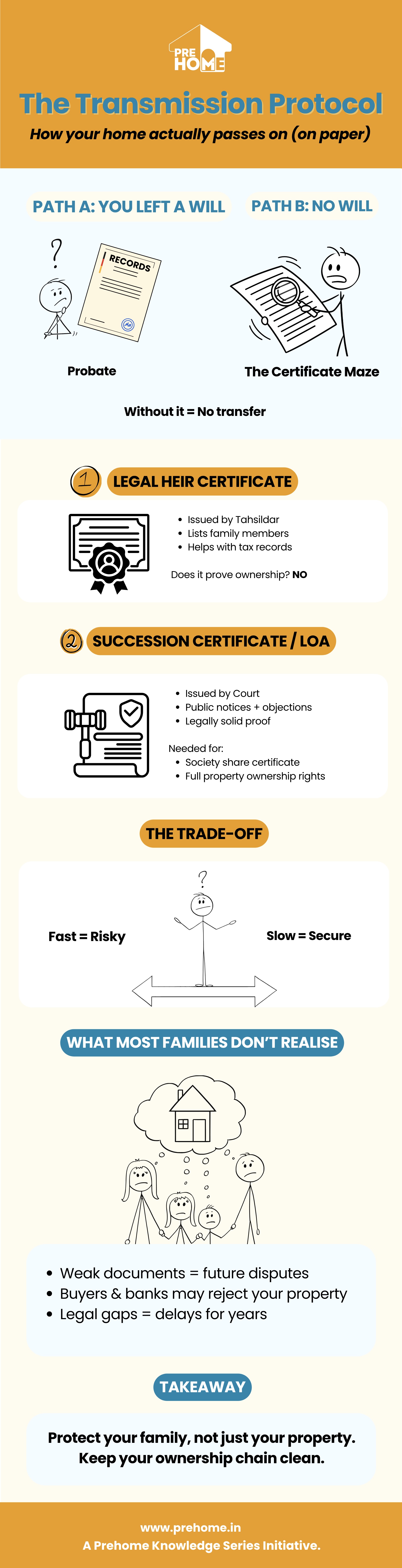
1. Path A: You Left a Will (Probate)
If you executed a Will, our heirs will probably need a Probate—a certificate from a High Court validating the Will.
-
- Probate is legally necessary for properties in Presidency towns (Mumbai, Kolkata, Chennai). Without it, the society will not transfer the flat.
2. Path B: You Died Intestate (The Certificate Maze)
If you did not leave a Will, your heirs must prove to the government and the housing society that they own the property. They will face two distinct documents:
-
- The Legal Heir Certificate (The Quick Fix) : Issued by the local Tahsildar or Revenue Officer. It simply lists the surviving family members.
- The Flaw : This is an administrative document, not a judicial one. It usually includes disclaimers stating it does not confer ultimate title. It may help with altering municipal records (Property Tax), but banks and savvy buyers often reject it as inadequate proof of ownership during a sale.
- The Succession Certificate & Letters of Administration (The Ironclad Proof) : Issued by a Civil Court after publishing notices in newspapers and inviting objections.
- A Succession Certificate is used to claim movable assets (including the Society Share Certificate).
- A Letter of Administration (LOA) is the court order needed to manage the immovable real estate.
- The Reality : While obtaining court documents takes 6–12 months, they are solid proof. The Tahsildar's Legal Heir Certificate leaves the door open for future disputes.
The Final Insight:
An inherited property with a confusing paper trail isn't a gift; it is a burden for future generations. Ensure your Chain of Title remains intact after you are gone.
You have now mastered the complete lifecycle of a primary home. But what happens if life forces a change of plans? What if you are transferred to another city, or decide to keep your first home as an investment? Suddenly, you are no longer just a homeowner; you are a landlord.
In Our Next Series :
Topic 15: The Accidental Landlord: Maximizing Yield & Minimizing Headaches