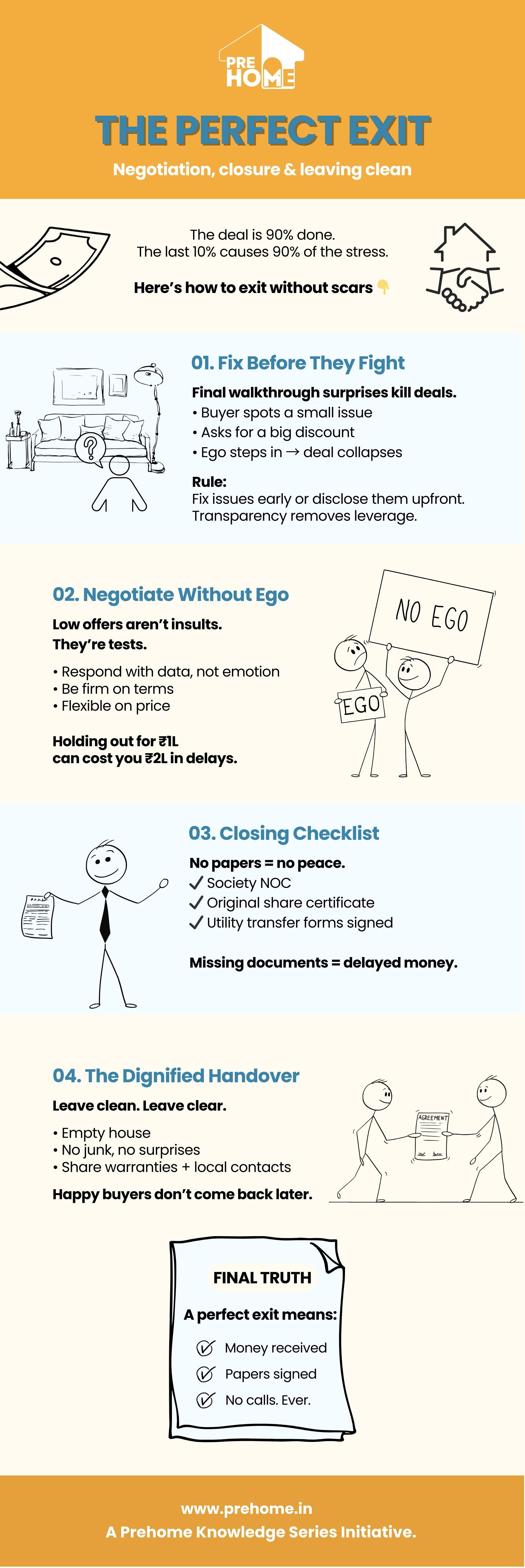
The Perfect Exit: Negotiation, Closure, and a Dignified Handover
You have navigated the Liquidity Trap and the Tax Maze. Now, you are at the table to sign. The deal is 90% done, but the last 10% causes most of the stress. A perfect exit isn’t just about the money; it’s about Closure. A messy sale can lead to legal notices or society disputes years later.
1. Pre-Fix vs. Post-Fight
-
- The Scenario : The buyer does a final walkthrough and finds a broken geyser. They demand a ₹50,000 price reduction.
- The Ego Trap : You refuse, thinking, "I already gave a discount!" The deal collapses over ₹50k on a ₹1 Cr asset.
- The Prehome Rule: Pre-empt the friction : Anticipate issues. Fix everything before the inspection. Or provide a disclosure list upfront: "The geyser is old, and the price reflects that." Transparency removes negotiation leverage.
2. Negotiation Without Ego
Your profit is taxable, but the rate depends on "Time."
-
- Handling Low-Ball Offers : A buyer offering 20% less isn’t insulting you; they are testing you. Respond with data, not emotion. "Recent sales in this building are at X; I cannot go below Y."
- The "One Last Lakh" : Experienced sellers know when to give in. Holding out for the last ₹1 Lakh often costs you ₹2 Lakhs in holding costs (EMI + maintenance) if the buyer backs out.
- The Verdict : Be firm on terms (timeline, payment mode), but flexible on price.
3. The Closing Checklist
Don't let bureaucracy delay your cheque. Have these ready:
-
- Society NOC : The "No Dues Certificate" from the RWA is necessary for transfer.
- Sale Deed : Hand over the original physical copy. If lost, getting a duplicate takes months—start now.
- Utility Transfer : Sign the transfer forms for electricity and gas when you register. Don’t leave it for “later”.
4. The Dignified Handover
The period between taking the “Token” and signing the “Deed” can be risky.
-
- The Clean Sweep : Hand over the house empty and clean. Don’t leave behind old paint cans or broken furniture.
- The "Manual" : Leave a file for the new owner with warranty cards for fittings, contact numbers for local plumbers/electricians, and society rules.
- The Psychology : A dignified handover helps the buyer feel good about the purchase, reducing the chance of them contacting you later with complaints.
The "Sleep" Test
A clean exit is one where the money hits your bank, the papers are signed, and you never hear from the buyer again. Speed and certainty are worth more than the highest possible price.
Conclusion
You have now completed the lifecycle of Homeownership—from Buying (Topic 1) to Living (Topic 11) to Selling (Topic 12). The cycle is complete. But for the wealthy, the game doesn't end at selling. It evolves into Leverage.